
 En
En
 عربى
عربى
Content
- 1 Why Embroidered Table Runners Stand Apart from Other Table Textiles
- 2 Base Fabric Options and How They Affect the Final Look
- 3 Embroidery Styles and What They Suit
- 4 Sizing an Embroidered Table Runner Correctly
- 5 Matching Embroidered Table Runners to Occasions and Seasons
- 6 Care and Maintenance of Embroidered Table Runners
An embroidered table runner is one of the most versatile and visually impactful textile accessories you can add to a dining table, console, sideboard, or event setup. Unlike a plain tablecloth that simply covers a surface, an embroidered runner adds texture, color, craftsmanship, and personality — it tells a story through its stitching and becomes a focal point rather than a background element. But with the enormous variety of embroidery styles, base fabrics, sizes, and design aesthetics available in the market, choosing the right embroidered table runner for a specific occasion, interior style, or practical requirement is not always straightforward. This guide covers the practical decisions involved — from fabric and embroidery type to sizing, care, and occasion matching — with enough specific detail to help you make a confident and satisfying choice.
Why Embroidered Table Runners Stand Apart from Other Table Textiles
A table runner occupies a specific functional and aesthetic role in table dressing: it runs lengthwise along the center of the table, defining the axis of the setting, protecting the table surface beneath, and providing a platform for centerpieces, candles, and serving dishes. Compared to a full tablecloth, a runner exposes the table surface on either side, which creates an opportunity to feature a beautiful wood grain, marble top, or glass surface as part of the overall composition rather than hiding it completely.
Embroidery elevates the table runner beyond a purely functional textile into an object of decorative value in its own right. Hand embroidery, in particular, carries the marks of the maker — slight irregularities in stitch tension, subtle variations in thread color, and the density of stitching that only comes from hours of skilled handwork. Machine embroidery achieves precision and consistency at scale, enabling complex designs to be reproduced reliably for commercial applications such as event hire, hospitality, and retail. Both forms have genuine merit, and understanding the difference helps buyers set appropriate expectations for what they are purchasing.
Base Fabric Options and How They Affect the Final Look
The base fabric of an embroidered table runner determines its drape, texture, weight, durability, and how well it accepts embroidery thread. Different fabrics create fundamentally different aesthetic results even when the embroidery pattern is identical, and the choice of base fabric should be guided by the intended use, the décor environment, and the level of care the runner will receive.
Linen
Linen is the most traditional and widely used base fabric for embroidered table runners, and with good reason. It has a natural matte texture that provides an excellent visual contrast to the sheen of embroidery thread, making stitched designs stand out clearly. Linen is strong, durable, and becomes softer with each wash without losing structural integrity. Its natural off-white or ecru color provides a warm neutral background that suits both traditional and contemporary embroidery designs. High-count linen — with a tighter weave and more threads per centimeter — provides a smoother surface that supports fine needlework and detailed embroidery patterns, while coarser linen gives a more rustic, artisanal character suited to casual dining and farmhouse-style interiors.
Cotton
Cotton is a practical and versatile base fabric for embroidered runners, particularly for everyday use and family dining where the runner will need frequent laundering. It is softer than linen, available in a wide range of thread counts and weave structures, and takes dye readily, making it the most common choice for brightly colored base fabrics. Cotton canvas or duck weave provides a stable ground for dense embroidery, while fine cotton voile or batiste allows for delicate cutwork and drawn-thread embroidery techniques that would not be possible on heavier base fabrics. The primary limitation of cotton compared to linen is its tendency to wrinkle more persistently and its slightly shorter lifespan under repeated washing at higher temperatures.
Velvet and Jacquard
Velvet and jacquard-woven fabrics are used for embroidered table runners intended for formal occasions, holiday settings, and luxury hospitality environments. Velvet's pile surface creates a rich, tactile background that makes gold or silver metallic embroidery thread appear especially luxurious — a combination frequently seen in festive and occasion dining. Jacquard fabrics incorporate woven patterns into the base fabric itself, and when combined with embroidery, produce a layered visual effect of considerable sophistication. Both fabrics require more careful handling and specialized cleaning compared to linen or cotton, making them more appropriate for occasional use than everyday dining.
Embroidery Styles and What They Suit
The style of embroidery on a table runner is as important as the base fabric in determining its overall character and suitability for different settings. Understanding the major embroidery styles helps buyers identify what they are looking at when comparing products and match the embroidery style to the intended décor context.
Crewelwork and Surface Embroidery
Crewelwork uses wool thread on a linen or linen-cotton ground to create flowing, naturalistic designs featuring flowers, leaves, vines, and botanical motifs filled with a variety of stitches including satin stitch, stem stitch, and long-and-short stitch. The thick wool thread creates a slightly raised, textured surface with a matte, velvety appearance. Crewelwork table runners suit traditional, English country house, and maximalist interior styles and work particularly well on long dining tables where the substantial visual weight of the embroidery can be appreciated at a distance.
Cross-Stitch and Counted Thread Embroidery
Cross-stitch embroidery creates designs from a grid of X-shaped stitches on evenweave or Aida fabric, producing geometric and pixelated patterns that range from folk art motifs to refined botanical designs. The precise, structured nature of cross-stitch suits Scandinavian, Eastern European folk, and cottage interior styles, and the geometric quality of the stitching can also complement contemporary or Bauhaus-influenced table settings when the design is sufficiently abstracted. Cross-stitch runners are typically the most accessible style for home embroiderers and are widely available as finished products across a broad price range.
Cutwork and Broderie Anglaise
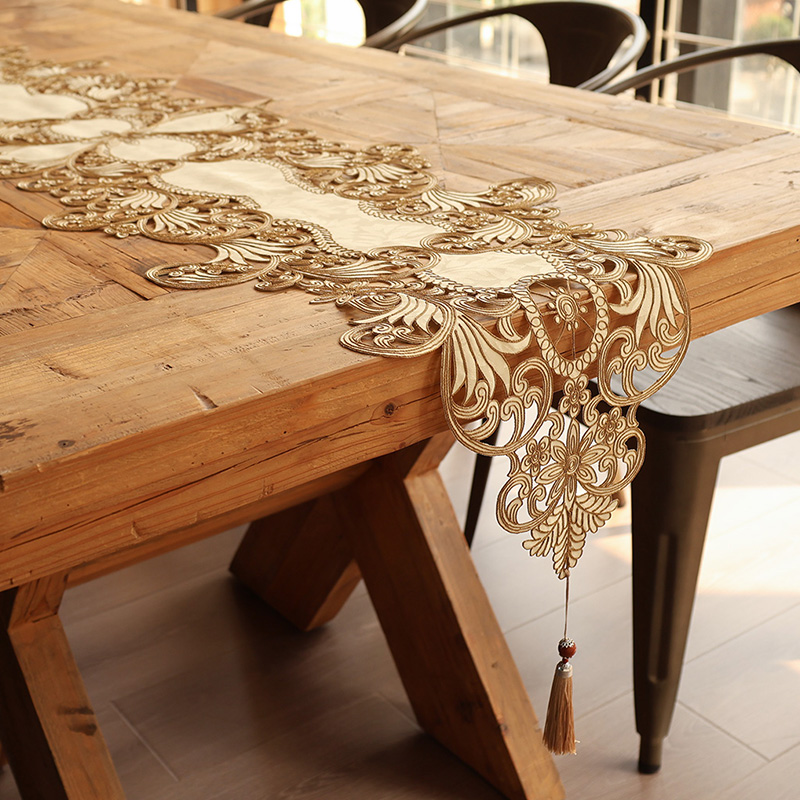
Cutwork embroidery involves cutting away areas of the base fabric within stitched outlines to create an open lacework effect. Broderie Anglaise — a specific form of cutwork using oval or round eyelets — produces the characteristic white-on-white pattern associated with Victorian and country cottage aesthetics. Cutwork table runners introduce lightness and transparency to the table setting, allowing glimpses of the table surface beneath through the open areas of the design. They are most effective on formal dining tables with polished wood or marble surfaces that benefit from being partially revealed, and their delicate appearance makes them ideal for garden parties, afternoon teas, and spring and summer entertaining.
Machine Embroidery and Digital Design
Modern machine embroidery uses computerized embroidery machines to stitch complex, multi-color designs with a precision and consistency that hand embroidery cannot match at scale. Machine-embroidered runners are available at a much wider range of price points than hand-embroidered equivalents, and the design possibilities are virtually unlimited — from photorealistic floral motifs to monograms, geometric abstracts, and custom branded designs for hospitality and events. The quality of machine embroidery varies considerably between manufacturers, with premium machine embroidery using high-density stitching, quality thread, and precise backing stabilization that produces results approaching the visual richness of hand embroidery.
Sizing an Embroidered Table Runner Correctly
Correct sizing is one of the most practically important decisions in selecting a table runner, and one that is frequently underestimated. A runner that is too short looks disconnected from the table; one that is too narrow disappears visually; one that is too wide encroaches on the place settings and creates a cluttered appearance. The following guidelines provide a reliable starting framework:
| Table Length | Recommended Runner Length | Overhang Each End |
| 120 cm (4 ft) | 150 – 160 cm | 15 – 20 cm |
| 150 cm (5 ft) | 180 – 200 cm | 15 – 25 cm |
| 180 cm (6 ft) | 210 – 230 cm | 15 – 25 cm |
| 240 cm (8 ft) | 270 – 300 cm | 15 – 30 cm |
Standard runner width ranges from 30 cm to 45 cm for most dining table applications. A width of 30–33 cm works well on tables up to 90 cm wide, while 40–45 cm widths suit wider tables and buffet or console surfaces where a more generous visual presence is appropriate. For round tables, a runner can be draped across the center diameter or used as a cross arrangement with two runners at right angles — in either case, allowing 15–20 cm of overhang at each end beyond the table edge creates an intentional, styled appearance rather than an accidental one.
Matching Embroidered Table Runners to Occasions and Seasons
One of the most practical advantages of table runners over full tablecloths is the ease with which they can be changed to reflect different occasions, seasons, and moods without the expense and storage demands of replacing an entire table covering. An embroidered runner investment should therefore be considered in terms of the range of occasions it will serve and how well its embroidery style, color, and motif translate across different contexts.
- Everyday dining: Choose a runner in a neutral linen or cotton base with restrained embroidery — a simple border design, a geometric edge motif, or a sparse botanical pattern in natural thread tones. The runner should be machine washable and sufficiently understated not to compete with the food and tableware it frames.
- Formal dinner parties: White or ivory linen with white or silver embroidery creates an elegant, refined backdrop for formal place settings. Alternatively, a deep-toned linen or velvet runner with gold metallic embroidery adds drama and warmth to evening dining. Either approach benefits from coordinating with napkin rings, candleholders, and flatware in a consistent metal tone.
- Seasonal and holiday tables: Seasonal runners allow quick, cost-effective table refreshes throughout the year. Deep red or forest green linen with holly, snowflake, or star embroidery suits winter holiday tables; pastel cotton with floral embroidery works for spring and Easter settings; harvest gold or burnt orange linen with botanical motifs suits autumn entertaining. Investing in two or three seasonal runners that coordinate with existing tableware provides year-round versatility.
- Weddings and special events: Event-specific embroidered runners — often with monograms, date embroidery, or floral motifs coordinated with the wedding color palette — have become a popular keepsake as well as a table decoration. For event hire and styling businesses, machine-embroidered runners in a neutral base with a versatile design offer maximum reusability across different events and client styles.
Care and Maintenance of Embroidered Table Runners
Proper care significantly extends the life and appearance of an embroidered table runner, and the care requirements should always be verified before purchase — particularly for runners that will see frequent use or need to be laundered after every dinner party. The following care principles apply across most embroidered runner types, with modifications for specific materials:
- Check the embroidery thread colorfastness before the first wash: Dampen a corner of the runner and press it against a white cloth — if color transfers, the embroidery thread is not colorfast and the runner should be hand-washed in cold water with a gentle detergent rather than machine-washed. This step prevents irreversible color bleeding onto the base fabric on the first wash.
- Turn the runner inside out for machine washing: Washing with the embroidered face against the drum protects the raised stitching from abrasion against the drum surface and other items in the load, extending the life of the embroidery surface significantly.
- Iron from the reverse side over a thick towel: Pressing an embroidered runner face-down over a folded towel allows the iron to smooth the base fabric without flattening the raised embroidery stitches. Ironing face-up with direct heat compresses the stitching and permanently reduces the three-dimensional texture that gives quality embroidery its visual depth.
- Store flat or rolled, never folded through the embroidery: Long-term folding creates permanent crease lines in both the base fabric and the embroidery thread. Store runners flat in a drawer or rolled around an acid-free tissue tube to maintain their appearance between uses.
 Previous



