
 En
En
 عربى
عربى
Content
- 1 What Are Embroidered Placemats and Why Do They Matter?
- 2 Base Fabric Options and Their Characteristics
- 3 Embroidery Techniques Used in Placemat Production
- 4 Popular Design Styles and Themes
- 5 Standard Sizes and Edge Finishing Options
- 6 How to Choose Embroidered Placemats for Your Table
- 7 Care and Maintenance of Embroidered Placemats
- 8 Embroidered Placemats as Gifts and Custom Orders
- 9 Conclusion
What Are Embroidered Placemats and Why Do They Matter?
Embroidered placemats are table linens featuring decorative needlework stitched directly onto the fabric surface, combining the practical function of protecting the table from heat, spills, and scratches with the aesthetic value of handcrafted or machine-embroidered design. Unlike plain woven or printed placemats, embroidered versions carry a tactile, dimensional quality that adds visual depth and a sense of craftsmanship to any table setting — whether a casual family breakfast or a formally laid dinner table. The embroidery can range from simple border stitching and monograms to elaborate floral motifs, geometric patterns, folk art designs, and seasonal or holiday themes.
The appeal of embroidered placemats extends well beyond aesthetics. They signal care and intentionality in table presentation, making them popular choices for gifting, wedding registries, holiday entertaining, and home decoration. In markets ranging from mass-produced machine-embroidered sets sold through home goods retailers to individually handcrafted pieces commissioned from artisans, embroidered placemats occupy a meaningful segment of the home textile industry. Understanding the materials, embroidery techniques, styles, and practical considerations involved in selecting and maintaining embroidered placemats helps buyers make informed choices that deliver both beauty and lasting value.
Base Fabric Options and Their Characteristics
The base fabric of an embroidered placemat determines its drape, durability, stain resistance, ease of care, and the way embroidery threads interact with the weave. Different fabric types suit different aesthetics and use contexts, and understanding these differences is essential when selecting placemats for a specific purpose.
Cotton and Cotton Blends
Cotton is the most widely used base fabric for embroidered placemats. Its natural fiber structure accepts embroidery thread anchoring extremely well, and the material is available in a wide range of weave densities — from lightweight muslin and voile to medium-weight quilting cotton and heavier canvas. 100% cotton placemats are breathable, comfortable under dishes and glassware, and launder well at moderate temperatures, though they can wrinkle and may require ironing after washing. Cotton-polyester blends reduce wrinkling and improve dimensional stability while retaining good embroidery compatibility, making them a popular choice for everyday use sets where low-maintenance performance is a priority.
Linen and Linen Blends
Linen is considered a premium base fabric for table linens, including embroidered placemats. Its naturally irregular, slightly textured weave provides an elegant backdrop for embroidery — the subtle variation in the fabric surface adds to the artisanal character of hand-embroidered designs in particular. Linen is stronger than cotton of equivalent weight, becomes softer and more supple with repeated washing, and has a natural ability to absorb moisture without feeling damp. Pure linen placemats wrinkle readily and require ironing or intentional "lived-in" styling, but linen-cotton blends offer a practical compromise with reduced wrinkling and retained textile quality. Linen's natural neutral color palette — ranging from off-white and cream to natural tan — complements a wide range of embroidery thread colors.
Jute, Burlap, and Natural Fiber Weaves
Jute and burlap placemats with embroidered accents have become popular in rustic, farmhouse, and bohemian table styling contexts. These open-weave natural fiber fabrics provide a coarse, visually textured base that contrasts dramatically with the smooth surface of embroidery threads, creating a striking artisanal effect. Embroidery on jute and burlap typically uses bold, simple motifs — geometric shapes, large floral outlines, or text — because the open weave makes fine detail difficult to achieve. These placemats are generally best suited to decorative or occasional use rather than heavy daily service, as natural fiber weaves can be more challenging to clean and may deteriorate faster than cotton or linen with repeated laundering.
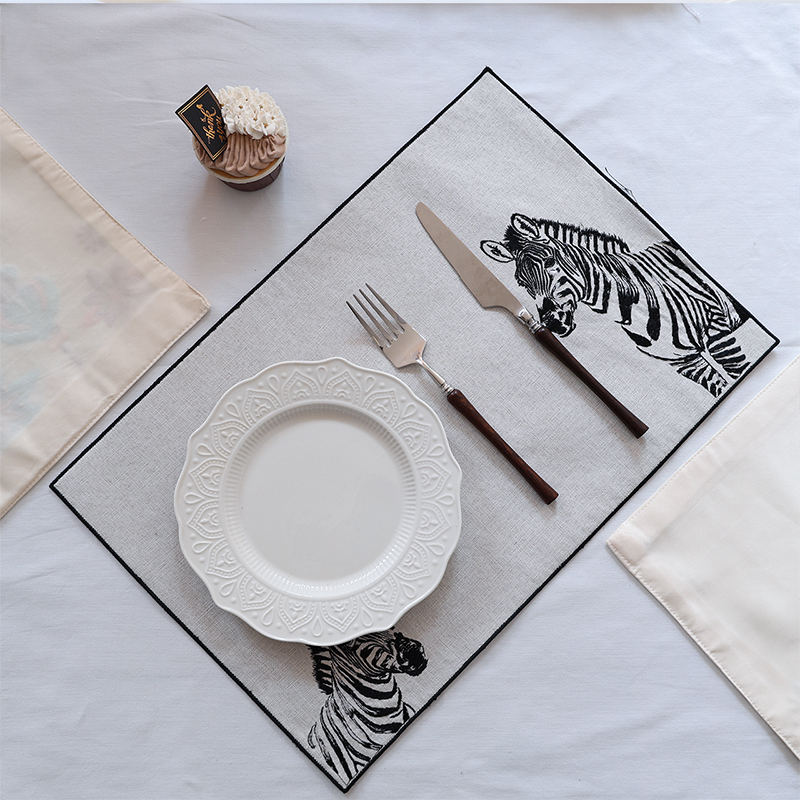
Polyester and Synthetic Fabrics
Machine-embroidered placemats are frequently produced on polyester or polyester-blend base fabrics because synthetic materials offer consistent thread count, dimensional stability during the embroidery process, and excellent resistance to wrinkling, fading, and staining in everyday use. Polyester placemats are highly practical and easy to care for — many are machine washable and dryer safe — making them well suited to households with children or for frequent formal entertaining where large sets need rapid laundering between uses. The trade-off is that polyester lacks the natural warmth and breathability of cotton or linen, and very fine or detailed embroidery designs may not achieve the same depth of appearance on a synthetic base as on a natural fiber weave.
Embroidery Techniques Used in Placemat Production
The embroidery on placemats can be executed by hand or machine, and the technique used significantly affects the visual character, production cost, and uniqueness of the finished piece. Both approaches have distinct advantages depending on the intended use and market segment.
Hand Embroidery
Hand-embroidered placemats are produced by skilled artisans who stitch designs manually using needles and thread. Common hand embroidery stitches used in placemat decoration include satin stitch (used to fill solid color areas with smooth, parallel thread coverage), chain stitch (for outlines and flowing linear designs), cross-stitch (characteristic of folk and traditional table linen styles), and French knots (creating textured dot accents within floral or decorative motifs). Hand embroidery is labor-intensive and therefore commands a higher price point, but it produces pieces with unique character — slight variations in stitching tension and placement that distinguish handmade work from mechanically produced alternatives. Hand-embroidered placemats are particularly valued as gifts, heirlooms, and collector pieces, and are a significant product category in cottage industries across South Asia, Eastern Europe, and Latin America.
Machine Embroidery
Machine embroidery uses computerized multi-needle embroidery machines programmed with digitized design files to stitch patterns onto fabric at high speed with exceptional consistency. Modern embroidery machines can execute designs with 15 or more thread colors, extremely fine detail, and precise registration across large production runs. Machine embroidery makes it economically viable to produce large sets of matching placemats at accessible price points while still delivering visually complex, colorful designs that would be prohibitively expensive to produce by hand. The digital nature of machine embroidery also enables easy customization — monograms, personalized text, or bespoke motifs can be digitized and stitched at moderate additional cost compared to completely custom hand embroidery.
Popular Design Styles and Themes
Embroidered placemat designs span an enormous range of aesthetics, from traditional to contemporary, allowing buyers to find options that complement virtually any interior style or occasion. The most commercially significant design categories include:
| Design Style | Key Visual Elements | Best Table Setting Context |
| Floral and Botanical | Roses, daisies, vines, leaves in multicolor thread | Cottage, romantic, spring and summer tables |
| Geometric and Ethnic | Repeating patterns, tribal motifs, bold color blocks | Bohemian, global-inspired, casual dining |
| Monogram and Initial | Single or double letter in classic or script font | Formal dining, gift sets, personalized bridal |
| Seasonal and Holiday | Snowflakes, pumpkins, holly, Easter motifs | Festive entertaining, holiday table decor |
| Minimalist and Contemporary | Simple border stitching, tone-on-tone thread, abstract forms | Modern interiors, Scandinavian-style tables |
| Folk and Traditional | Cross-stitch patterns, regional folk motifs, handcraft aesthetic | Rustic, farmhouse, heritage-style dining rooms |
Standard Sizes and Edge Finishing Options
Embroidered placemats are produced in a range of standard sizes, with the most common rectangular format measuring approximately 30 x 45 cm (12 x 18 inches) — a dimension that comfortably accommodates a dinner plate, cutlery, and a glass without crowding. Larger formats of 33 x 48 cm (13 x 19 inches) or 35 x 50 cm (14 x 20 inches) are also widely available, providing more generous coverage for larger place settings or oversized dinner plates. Round and oval placemats in diameters of 35–40 cm are popular for circular table formats or as charger liner alternatives.
The edge finishing of an embroidered placemat contributes significantly to its visual refinement and durability. Common edge treatments include:
- Hemstitched borders: A traditional drawn-thread technique where threads are pulled from the fabric and the remaining threads are grouped and stitched to create a decorative ladder or zigzag openwork border — highly characteristic of fine linen table linen traditions.
- Mitered corners with topstitched hem: The most common finish on machine-produced placemats, providing a clean, flat edge with neatly folded and stitched corners that lie flat without bulk.
- Overlock or serged edges: A practical, durable edge finish where the raw fabric edges are wrapped with thread to prevent fraying — common on casual-use cotton and polyester placemats where a utilitarian finish is acceptable.
- Fringe and tassel borders: Fabric threads along the placemat edges are deliberately left unfinished and combed out to create a fringe border — a popular aesthetic in bohemian, Mexican, and rustic-style table linens that adds texture and visual interest.
- Lace and broderie anglaise trim: A delicate lace or cutwork cotton trim attached around the placemat perimeter, adding a romantic or vintage character particularly suited to floral embroidery designs.
How to Choose Embroidered Placemats for Your Table
Selecting the right embroidered placemats for a given context requires balancing aesthetic preferences with practical requirements. The following considerations help narrow the choice to options that will satisfy both decorative and functional needs over time.
- Match the design to the table setting style: Bold, multicolor embroidery works well on plain tablecloths or bare wood tables where the placemats serve as the primary decorative element. Tone-on-tone or minimalist embroidery complements patterned tablecloths or highly styled table settings without competing for visual attention.
- Consider frequency and type of use: Daily family dining demands machine-washable, wrinkle-resistant fabrics — polyester-cotton blends or treated cotton sets are practical choices. For occasional formal entertaining or display purposes, pure linen or hand-embroidered cotton sets deliver superior quality and presence even if they require more careful laundering.
- Check set size against table capacity: Standard sets are sold in groups of 4 or 6. Confirm the set size matches your typical dining group to avoid mismatched or incomplete table settings. If entertaining large groups occasionally, purchasing two sets of the same design is more practical than seeking larger sets.
- Evaluate thread color fastness: For colorful embroidered designs, verify that the thread colors are rated for colorfastness to washing and light exposure. Poorly dyed threads may bleed during first washing or fade rapidly with regular use — look for product descriptions that specify colorfast or pre-washed thread treatments.
- Assess padding and heat protection: Thin embroidered placemats on their own provide minimal protection against hot dishes. If heat resistance is important, choose placemats with a padded or quilted interlining, or use a separate silicone or cork trivet under very hot cookware to protect the embroidered fabric from heat damage and discoloration.
Care and Maintenance of Embroidered Placemats
Proper care is essential to preserving the quality of embroidered placemats, particularly the dimensional integrity and color vibrancy of the embroidery threads. General care guidelines applicable to most embroidered placemat sets include:
- Launder at 30–40°C using a gentle or delicate machine cycle to prevent thread shrinkage, distortion of the embroidery, or abrasion of the stitched surface against other items in the drum.
- Turn placemats embroidery-side inward before washing to reduce friction on the stitched surface and protect thread integrity during agitation.
- Avoid chlorine bleach on colored or multi-thread embroidered designs, as bleach causes thread color degradation and can weaken natural fiber threads. Use oxygen-based stain removers for spot treatment of food or beverage stains before laundering.
- Air dry flat or tumble dry on low heat — high dryer temperatures can cause cotton and linen placemats to shrink and may cause synthetic thread to develop an unpleasant sheen or become brittle over time.
- Iron on the reverse side of the embroidery using a pressing cloth between the iron and the fabric — direct high heat on embroidered surfaces can flatten the dimensional relief of raised stitches and cause some thread fibers to scorch or melt.
- Store flat or loosely rolled rather than folded sharply along embroidered areas, as repeated folding along the same crease line can weaken thread anchoring points and cause premature wear at fold lines.
Embroidered Placemats as Gifts and Custom Orders
Embroidered placemats are among the most appreciated home textile gifts because they combine practical utility with evident craftsmanship and personalization potential. Monogrammed sets — featuring the recipient's initials or a family name embroidered in a chosen thread color and font — are popular choices for weddings, housewarmings, anniversaries, and milestone birthdays. Many specialty embroidery businesses and online craft marketplaces offer custom orders where buyers specify the design, thread colors, base fabric, and size to create a completely personalized set.
For buyers sourcing embroidered placemats in wholesale quantities — for restaurant table service, hotel amenity sets, or retail gift collections — it is important to request production samples before committing to full orders, verify that the supplier's embroidery machines produce consistent stitch density and thread tension across all units in a run, and confirm that base fabric and thread specifications meet applicable safety and chemical compliance standards for food contact textiles (such as OEKO-TEX Standard 100 certification), which ensures that no harmful substances are present in the finished product at levels of concern for consumer use.
Conclusion
Embroidered placemats occupy a unique position in the home textile market — simultaneously practical table protectors and decorative expressions of personal style, craftsmanship, and hospitality. From the base fabric choice between cotton, linen, and synthetic blends to the selection of hand or machine embroidery, design theme, edge finish, and care requirements, every aspect of an embroidered placemat contributes to its suitability for a given table setting and use context. By understanding these factors in depth, buyers can select embroidered placemats that enhance their tables beautifully, perform reliably through regular use and laundering, and represent lasting value — whether chosen for everyday family dining, festive entertaining, or as a thoughtful handcrafted gift.
 Previous



