
 En
En
 عربى
عربى
Content
- 1 Why a Proper Fit Makes All the Difference for Embroidered Tablecloths
- 2 Measuring Your Table Accurately Before You Start
- 3 Choosing the Right Fabric for Hand Embroidery
- 4 Planning Your Embroidery Design to Suit the Tablecloth Size
- 5 Selecting Threads and Stitches for Lasting Results
- 6 Finishing the Edges to Complement the Embroidery
- 7 Caring for Your Hand Embroidered Tablecloth
Why a Proper Fit Makes All the Difference for Embroidered Tablecloths
A hand embroidered tablecloth is more than a functional piece of linen — it is a centerpiece that reflects craftsmanship, personal style, and attention to detail. However, even the most intricate embroidery loses its visual impact when the cloth is the wrong size. A tablecloth that is too short looks awkward and leaves table edges exposed, while one that is too long bunches on the floor and creates a tripping hazard. Getting the fit right before you begin stitching is the single most important step in making embroidered tablecloths that look polished and professional in any setting — from everyday family dinners to formal occasions.
Unlike ready-made tablecloths, hand embroidered versions require you to plan your dimensions before cutting the fabric and before placing a single stitch. Because embroidery is time-consuming and the thread work is permanent, errors in sizing discovered after embroidering are extremely difficult to correct. This guide walks you through every practical step — from accurate measurement and fabric selection to design placement and finishing — so your embroidered tablecloth fits perfectly and showcases your needlework to its full potential.
Measuring Your Table Accurately Before You Start
Accurate measurement is the foundation of a well-fitting tablecloth. You will need to measure both the tabletop and decide on your desired drop length — the amount of fabric that hangs over each side of the table. Drop length is a matter of both function and style, and getting it right sets the tone for the entire piece.
Standard Drop Length Guidelines
Drop length varies by occasion and personal preference. The following are widely accepted standards used by professional linen makers:
| Occasion | Recommended Drop | Visual Effect |
| Casual / Everyday | 15 cm – 20 cm (6"–8") | Neat, practical, easy to seat guests |
| Formal Dining | 25 cm – 30 cm (10"–12") | Elegant, classic, traditional look |
| Decorative / Display | Floor length (full drop) | Dramatic, luxurious, event styling |
To calculate your total fabric dimensions, use this formula: Final Length = Table Length + (2 × Drop) + (2 × Hem Allowance). Apply the same formula for width. A standard hem allowance is 2–3 cm on each side if you plan a folded hem, or 1–1.5 cm for a rolled hem. Always add an extra 5 cm overall to account for any fabric shrinkage after pre-washing.
Measuring Round and Oval Tables
For round tables, measure the diameter across the widest point and add twice your desired drop plus hem allowance. For oval tables, measure both the longest length and the widest width separately, then apply the drop formula to each dimension independently. Always measure at multiple points to detect any inconsistencies in the tabletop surface, which is common in older or handmade furniture.
Choosing the Right Fabric for Hand Embroidery
The fabric you choose directly affects how well your embroidery looks, how easy it is to stitch, and how the finished tablecloth holds up over time. Not all fabrics are suitable for hand embroidery — grain stability, thread count, and surface texture all matter significantly.
- Linen: The gold standard for embroidered tablecloths. Linen has a natural weave that is easy to count and stitch through, holds its shape beautifully, and becomes softer with washing without losing structure. It is ideal for cross stitch, satin stitch, and drawn thread work.
- Cotton: A more affordable alternative, cotton fabric (especially high thread count quilting cotton or Aida cloth) is beginner-friendly and widely available. It accepts most embroidery styles well and is machine washable, making it practical for everyday use.
- Linen-Cotton Blend: Offers the best of both worlds — the texture and appearance of linen with the affordability and ease of cotton. This is a popular choice for home embroiderers working on large tablecloth projects.
- Evenweave Fabric: Designed specifically for counted embroidery techniques, evenweave has an equal number of threads per inch in both directions, making it ideal for precise pattern reproduction.
Always pre-wash and press your fabric before cutting it to final size. Most natural fabrics shrink 3%–5% after the first wash. Skipping this step and discovering shrinkage after completing the embroidery is one of the most common — and frustrating — mistakes in tablecloth making.
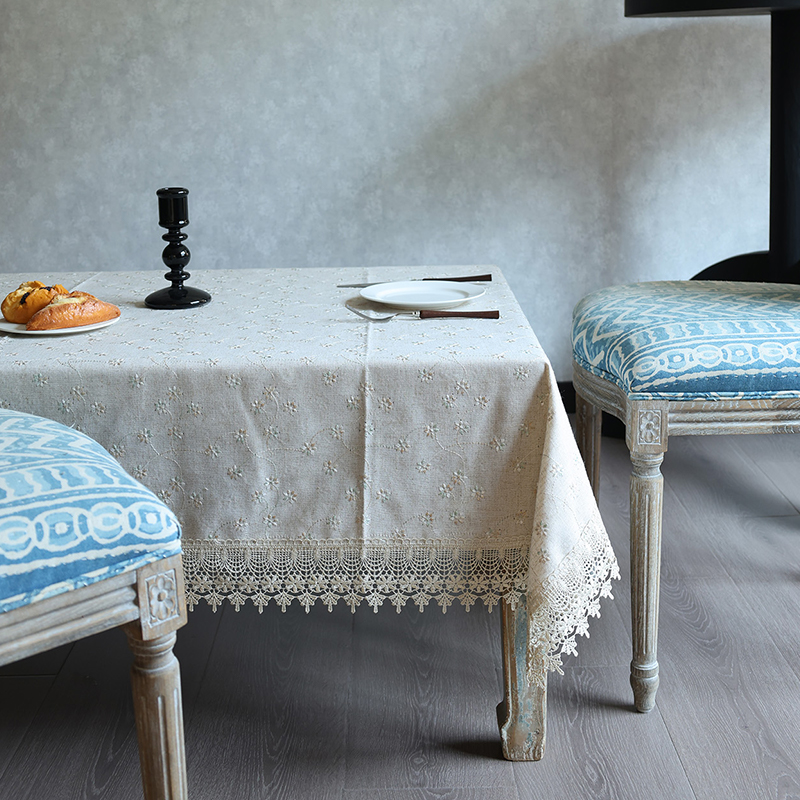
Planning Your Embroidery Design to Suit the Tablecloth Size
The embroidery design should be planned in proportion to the tablecloth dimensions. A large dining table cloth calls for bolder motifs or repeating border patterns, while a small side table cloth looks best with a centered single motif or delicate corner accents. The key is to balance negative space (unembroidered fabric) with stitched areas — too much embroidery on a large cloth feels overwhelming, while too little appears sparse and unfinished.
Marking the Design on Fabric
Use a water-soluble fabric marking pen or dressmaker's chalk to transfer your design onto the fabric before stitching. For symmetrical border patterns, fold the fabric into quarters and mark the center point — this ensures your design is evenly distributed on all sides. If you are working from a printed pattern, use a light box or tape the pattern to a bright window to trace it accurately onto the fabric surface.
Common Design Placements for Tablecloths
- Border Design: A continuous pattern running along all four edges — or just the two short ends — creates a framed appearance and is one of the most traditional styles for embroidered tablecloths.
- Corner Motifs: Identical embroidered motifs at each corner work well for formal dining cloths and are easier to execute than full borders, especially for beginners.
- Center Medallion: A single large motif centered on the cloth creates a focal point that works beautifully for round or square tables.
- Scattered Fill Pattern: Small repeating motifs distributed evenly across the surface create a vintage or folk art aesthetic, often seen in Eastern European and Latin American embroidery traditions.
Selecting Threads and Stitches for Lasting Results
Thread choice affects the durability, texture, and visual richness of your embroidered tablecloth. For tablecloths that will be used and laundered regularly, colorfastness is non-negotiable. Always choose threads rated for washing, and test a small sample before committing to the full project. DMC and Anchor six-strand cotton floss are the most widely trusted options for hand embroidery on table linens — both offer a broad color range and excellent wash stability.
Pearl cotton (also called Perle cotton) is a twisted, non-divisible thread that creates a raised, lustrous surface ideal for decorative borders and satin stitch fills. For drawn thread work or hemstitch embroidery — techniques commonly used along tablecloth hems — linen thread or matching cotton thread in a slightly heavier weight gives the clearest visual definition. Silk threads, while beautiful, are best reserved for decorative-only cloths that will not face regular washing.
Finishing the Edges to Complement the Embroidery
The hem finish is the final detail that ties the entire tablecloth together. A poorly finished edge undermines even exceptional embroidery. The most common hem styles for embroidered tablecloths include the mitered corner hem, the rolled hem, and the hemstitched border — each of which contributes differently to the overall appearance.
- Mitered Corner Hem: Fabric corners are folded diagonally to create neat, flat 45-degree joins. This is the most professional-looking finish and is standard on high-quality table linens. It requires careful pressing and hand stitching at the corner junction.
- Rolled Hem: A very narrow hem (2–3mm) rolled and stitched by hand gives a delicate, lightweight edge suitable for fine cotton or linen. It is time-intensive but highly elegant on formal tablecloths.
- Hemstitch Border: A decorative embroidery technique worked directly into the hem area, where threads are withdrawn from the fabric and the remaining threads are gathered into ladder or zigzag bundles. This finish is both functional and ornamental, and is a hallmark of traditional European table linen craftsmanship.
Complete all hemming before beginning the embroidery if your design is positioned near the edge — this ensures the hem folds do not distort the embroidered motifs. If your design is centered or placed well away from the edges, you may prefer to embroider first and hem last, which allows for minor dimensional adjustments if the fabric shifted slightly during the stitching process.
Caring for Your Hand Embroidered Tablecloth
Proper care extends the life of embroidered tablecloths significantly. Hand wash in cool water with a gentle, pH-neutral detergent, or machine wash on a delicate cycle in a mesh laundry bag. Never wring or twist the fabric — roll it gently in a clean towel to remove excess water, then lay flat or hang to dry away from direct sunlight, which can fade thread colors over time. When ironing, always press from the reverse side using a pressing cloth placed over the embroidery to protect raised stitches from being flattened. Store the tablecloth rolled rather than folded to prevent permanent crease lines from forming across embroidered areas.
 Previous



