
 En
En
 عربى
عربى
Content
- 1 What Sets Embroidered Tablecloths Apart from Printed Alternatives
- 2 Base Fabric Options and How They Affect the Final Look
- 3 Common Embroidery Styles and Their Appropriate Settings
- 4 Sizing Guide: Matching Tablecloth Dimensions to Your Table
- 5 Laundering and Storage to Protect the Embroidery
- 6 Evaluating Quality When Buying Embroidered Tablecloths
What Sets Embroidered Tablecloths Apart from Printed Alternatives
Embroidered tablecloths differ from printed or jacquard-woven designs in one fundamental way: the decorative motifs are built up from thread stitched onto the fabric surface rather than dyed into the weave or woven as part of the base structure. This distinction matters for durability, texture, and visual depth. Embroidery thread — whether cotton, silk, rayon, or metallic — sits proud of the fabric ground, creating a tactile relief that catches light differently depending on stitch direction and thread sheen. This quality makes embroidered tablecloths particularly effective in candlelit or low-light dining settings, where the dimensional texture of the stitching becomes visually prominent in ways that flat-printed fabrics cannot replicate.
From a production standpoint, embroidered tablecloths are produced through two distinct methods: hand embroidery and machine embroidery. Hand-embroidered pieces — particularly those originating from established textile traditions in Portugal, India, China, and Eastern Europe — command higher prices and exhibit the minor irregularities that authenticate handwork. Machine-embroidered tablecloths, produced on multi-head computerized embroidery machines, offer consistent stitch density and pattern registration at lower cost per unit, making them the dominant format in retail and hospitality supply channels.
Base Fabric Options and How They Affect the Final Look
The ground fabric beneath the embroidery determines how the finished tablecloth drapes, launders, and ages. Choosing the correct base fabric for the intended use is as important as selecting the embroidery pattern itself, and the two decisions interact: certain stitch types and thread weights perform better on specific fabric constructions.
Cotton and Cotton-Linen Blends
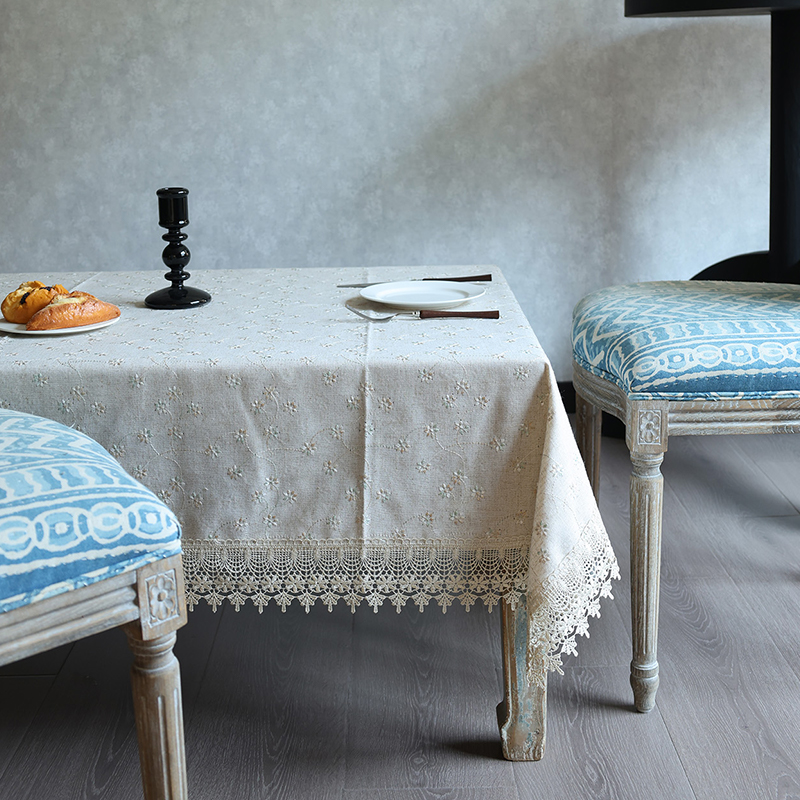
Plain-weave and twill cotton fabrics are the most common base for everyday embroidered tablecloths. They accept embroidery thread cleanly, launder repeatedly without significant shrinkage when pre-washed, and provide a stable ground that does not distort under the tension of dense stitch fills. Cotton-linen blends — typically 55% linen, 45% cotton — offer a slightly coarser texture that enhances the contrast between ground fabric and embroidery, and the linen component improves dimensional stability in humid conditions. These blends are a practical choice for dining tablecloths that will see regular use and frequent washing.
Pure Linen
Pure linen tablecloths with embroidered borders or central medallions are the traditional format for formal European table settings. Linen's natural lustre complements silk or rayon embroidery thread particularly well, and the fabric softens and improves in appearance with each wash over its service life. The main practical consideration with linen is its tendency to crease sharply — embroidered linen tablecloths typically require ironing on the reverse side to avoid flattening the raised embroidery, and storage should be flat or loosely rolled rather than tightly folded to prevent permanent crease marks along fold lines.
Polyester and Polyester-Cotton
Polyester-base embroidered tablecloths are the dominant format in hospitality, event hire, and contract catering supply. Polyester resists staining more effectively than natural fibres, dries quickly, and requires minimal ironing after washing. The trade-off is that polyester has a slightly plastic handle compared to linen or cotton, and the fabric's lower breathability can feel less comfortable in extended close-contact use. For event and banqueting applications where tablecloths are changed between seatings and laundered industrially, these practical characteristics outweigh the tactile limitations.
Common Embroidery Styles and Their Appropriate Settings
Embroidery style — the combination of motif type, stitch technique, and thread colour palette — determines how a tablecloth reads in a specific interior context. The following styles represent the most widely available formats and their natural applications.
- Whitework embroidery: White or off-white thread on a white or ecru ground, using techniques such as broderie anglaise (with cutwork eyelets), Hardanger, or shadow work. Whitework tablecloths suit formal dining rooms, wedding receptions, and christening or baptism table settings where an elegant, restrained aesthetic is appropriate.
- Coloured floral embroidery: Multi-colour thread motifs depicting stylised flowers, leaves, or botanical arrangements on a natural or coloured ground. This is the most versatile category, suitable for casual family dining, brunch settings, and country-style or farmhouse interiors. Portuguese and Mexican embroidered tablecloths in this style are particularly well-regarded for their colour saturation and stitch density.
- Geometric and ethnic patterns: Repeating geometric motifs drawn from Central European, Scandinavian, or Middle Eastern textile traditions. These patterns work well in contemporary interiors and minimalist dining spaces where a single bold tablecloth anchors the table setting without competing with other decorative elements.
- Monogram and personalised embroidery: Single initials, family crests, or custom text embroidered at a corner or central position. Monogrammed tablecloths are a traditional wedding gift format and are produced to order by both specialist embroidery studios and online customisation services with typical lead times of one to three weeks.
- Metallic thread embroidery: Gold or silver metallic thread incorporated into floral or geometric designs. Best suited to festive and holiday table settings — Christmas, Eid, Diwali, and formal dinner parties — where the reflective quality of metallic thread contributes to the celebratory atmosphere.
Sizing Guide: Matching Tablecloth Dimensions to Your Table
Correct sizing is critical for embroidered tablecloths because the embroidered border or edge detail — often the most visually prominent element — must fall at the correct position relative to the table edge and the seated guest. The standard drop length (the amount of fabric that hangs below the table edge on each side) varies by context: 20–30 cm for casual dining, 30–40 cm for formal seated dinners, and full floor-length drops for buffet tables and reception displays.
| Table Size | Table Dimensions | Casual Drop (20 cm) | Formal Drop (35 cm) |
|---|---|---|---|
| 4-seat rectangular | 140 × 80 cm | 180 × 120 cm | 210 × 150 cm |
| 6-seat rectangular | 180 × 90 cm | 220 × 130 cm | 250 × 160 cm |
| 8-seat rectangular | 220 × 100 cm | 260 × 140 cm | 290 × 170 cm |
| Round (4–6 seat) | 120 cm diameter | 160 cm round | 190 cm round |
For tablecloths with a prominent embroidered border, confirm that the drop length positions the border detail at a visible height above the seat level of your chairs — typically 15–25 cm above the seat surface. A border that falls below the chair seat line will be obscured entirely when guests are seated, defeating the purpose of the decorative edging.
Laundering and Storage to Protect the Embroidery
Embroidered tablecloths require slightly more care than plain fabric tablecloths because the raised thread work is vulnerable to snagging, pilling, and colour bleed if laundered incorrectly. Following the correct process significantly extends the service life of the embroidery and prevents the most common damage modes.
Washing
Machine washing at 30–40°C on a gentle or delicate cycle is appropriate for most cotton and linen embroidered tablecloths with colourfast thread. Turn the tablecloth inside out before washing to reduce abrasion on the embroidery surface and prevent thread snagging on drum ridges or other items in the load. Use a mild liquid detergent rather than powder, as undissolved powder particles can lodge in dense embroidery stitching and cause localised bleaching or abrasion. Avoid fabric softener on linen tablecloths — softener coats linen fibres and progressively reduces the natural crisp handle that is one of linen's key aesthetic qualities.
Ironing
Always iron embroidered tablecloths on the reverse side, placing the embroidered face down on a thick towel or pressing cloth. Direct iron contact on the embroidery surface flattens the raised stitch work and can cause permanent damage to metallic or rayon threads that have a lower heat tolerance than cotton. Iron while the fabric is still slightly damp for linen and cotton-linen blends, working with the grain of the fabric to avoid introducing bias distortion.
Storage
Store embroidered tablecloths either flat in a drawer or rolled around an acid-free cardboard tube — the same technique used for storing fine tapestries and textile artworks. Rolling prevents the sharp crease lines that develop when fabric is folded repeatedly along the same lines, which eventually weaken the fibres at the fold. If folding is unavoidable due to storage space constraints, refold along different lines each time the tablecloth is stored to distribute the stress across the fabric rather than concentrating it at a single point. For long-term storage, wrap in acid-free tissue paper rather than plastic bags, which trap moisture and can promote mildew growth on natural fibre textiles.
Evaluating Quality When Buying Embroidered Tablecloths
Quality variation in embroidered tablecloths is significant, particularly in the mid-price retail segment where machine-embroidered products from different production origins are sold at similar price points with very different underlying quality levels. The following indicators help distinguish well-made pieces from inferior alternatives before purchase.
- Thread density and coverage: In high-quality embroidery, satin stitch fills should cover the ground fabric completely with no gaps between thread rows. Thin or patchy fill coverage indicates a lower stitch count setting on the embroidery machine, which reduces the visual impact and long-term durability of the motif.
- Reverse side finish: Examine the back of the tablecloth. Well-executed machine embroidery shows clean thread paths between motif sections with minimal jump stitches (floating thread connections between design elements). Excessive jump stitches on the reverse indicate a less refined embroidery digitising file and increase the risk of thread snags during use.
- Hem and edge finishing: The hem should be mitre-folded at corners rather than simply overlapped, and the hem stitch should be consistent in depth around the full perimeter. On embroidered tablecloths with cutwork or drawn-thread borders, inspect the buttonhole stitching around cutwork edges for consistency and thread security — loose or irregular stitching at these points is the first area to deteriorate with washing.
- Colorfastness documentation: For tablecloths with coloured embroidery thread, request or check for ISO 105 colorfastness ratings, particularly for washing (C06) and rubbing (X12). A minimum rating of 4 on both scales is appropriate for a tablecloth that will be laundered regularly.
 Previous



